What is Solution Checker and App Checker in Power Apps – Quick recap

Hi Folks,

While its been quite sometime since Microsoft shipped the Solution checker and App checker, these tools can help a developer to validate all the solutions that was being built before moving to higher environments. It is always advisable to run solution checker once your solution is developed so this can help you achieve better performance following the Power Platform best practices. Previously we used to send for Code review to senior folks but now with this tool, even the junior developer working at the ground level can easily understand and can make the necessary tweaks in the solution.

Solution Checker serves as a static analysis tool for the developers to check any platform related issues.

The solution checker analyzes these solution components:

  • Dataverse custom workflow activities
  • Dataverse web resources (HTML and JavaScript)
  • Dataverse configurations, such as SDK message steps

Note: Solution checker won’t analyze plugins in solutions. Plugin validations are modernized and will eventually the focus is on the native plugin authoring time, which will help you detect and fix issues earlier. So if you were looking for improvements in Plugin code, this will not help you.

Once solution checker starts running, it will be shown as below with a loading symbol on solution checker

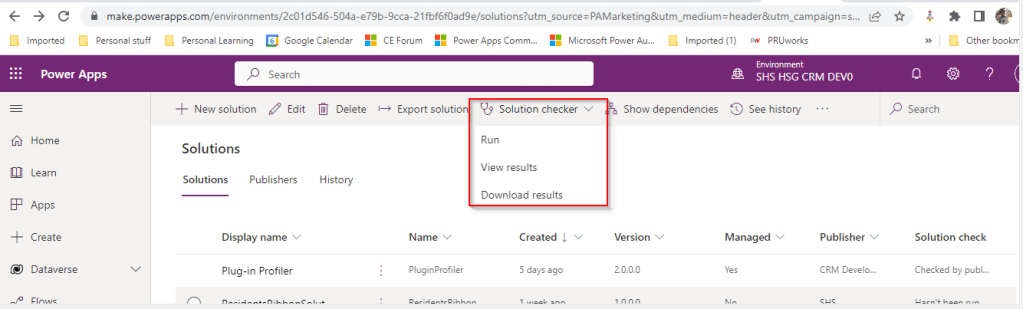
It would take a few minutes to complete the process and will be based on the size of the solution. Once this process is complete, you should be able to download the results or view the results like below
If we open the results file, it shows the potential issues or improvements along with their severity which helps us to prioritize the issues which we need to work upon.
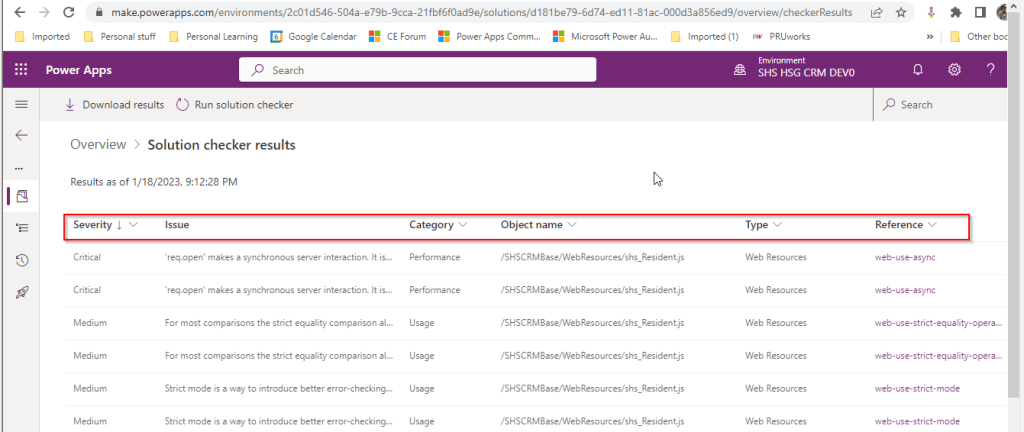
The report can also be downloadable excel file with analysis shipped in Zip format.

Now that we have seen what is solution checker, let’s see what App checker is and its pro’s and con’s.

App Checker:

  1. The App checker is now available to help provide a clear list of formula issues in your app, and to provide items to fix to make your app accessible
  2. This helps to make debugging, performance and best practice decisions an easier and more guided experience.  
  3. This is an ideal way to check the formulas you wrote for your Canvas Apps.
  4. There isn’t any possibility to download the app checker results but you can analyze the results on the fly in canvas apps.

To conclude you can think of Solution checker is a tool to check Model Driven Apps and App checker is a tool for Canvas Apps. Hope you will use this great features to improve your solutions and design according to best practices.

Reference:

Solution checker from MS Learn

Apps checker from MS Learn

Cheers,

PMDY

Top Picks for Power Apps

Top Picks for Power Automate

Top Picks for Microsoft Azure

Environment variables in Power Platform makes your life easier – Quick recap…

Often there is a need to use some kind of configuration for your customizations to work across environments in Power Platform or for storing the 3rd party URLs like SharePoint, other API services etc…previously there were ways where you can store your config but now with this helps in efficient way of interacting with your configuration across environments.

One environment variable can be used across many different solution components – whether they’re the same type of component or different ex. Power Apps and Flow can use the same variable in the environment. Environment variables store the parameter keys and values, which then serve as input to various other application objects.

Additionally, if you need to retire a data source in production environments, you can simply update the environment variable values with information for the new data source. The apps and flows don’t require modification and will start using the new data source.

The environment variables can be unpacked and stored in source control. You may also store different environment variables values files for the separate configuration needed in different environments. Solution Packager can then accept the file corresponding to the environment the solution will be imported to. Thanks @Rezza Dorani for the video…

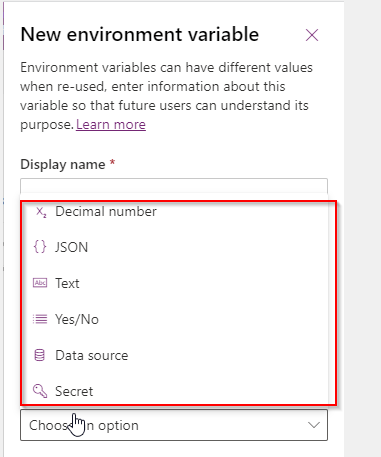
The following environment variables are available as on today…

Use cases:

  1. Access Environment variables in Plugins
  2. Get & Set Environment variables using Javascript

Few Advantages:

  1. Environment variables are supported in custom connectors.
  2. Provide new parameter values while importing solutions to other environments. 
  3. Supported by Solution Packager and DevOps tools enable continuous integration and continuous delivery (CI/CD).
  4. Its very easy to maintain datasources in Environment variables.
  5. Its ideal for passing any parameters to bound or unbound actions from Power Automate.

Neverthless there were few limitions:

  1. When environment variable values are changed directly within an environment instead of through an ALM operation like solution import, flows will continue using the previous value until the flow is either saved or turned off and turned on again.
  2. If the environment value is changed, it may take up to an hour to fully publish updated environment variables.
  3. If you made the same mistake as I did and imported a Managed Solution without a Current Value, added a Current Value for the first time and cannot edit the new Current Value anymore.
  4. It looks like a potential risk.

Hope this post helped in some way…please let me know if you have any questions….

Cheers,

PMDY