Execution Timeout Expired. The timeout period elapsed prior to completion of the operation, or the server is not responding – Troubleshooting timeouts in Power BI

Hi Folks,

When I was working with my Power BI reports, I suddenly started encountering this error. I don’t have any more clue except this error message which I could see in my Power BI Desktop as below. Initially I thought there could be some problem connecting to my SQL end point of my Dataverse connection, but it isn’t.

The error message above clearly say that the Queries are blocked. I then quickly started reviewing the model of the Power BI Report to see if there were any issues like the Relationships etc. But I couldn’t find anything in my relationships. Since I was using SQL Connection to my Dataverse, I tried to increase the Command timeout in minutes (max value being 120 minutes) from Advanced options of my connection but still the same error.

Cause: Then I quickly noticed that in my model I have fetched the same table data both using Direct Query and Import mode. So, when I was refreshing, because of the relationships, the one imported is being dependent on the one with Direct Query.

Fix: After review, the unnecessary Direct Query table was removed and voila it fixed the issue.

If anyone is facing the same problem, I strongly recommend you review the Semantic Model of your Power BI Report.

Cheers,

PMDY
Enabling TDS End Point for Dataverse (Preview Feature) from Power Platform Admin Center and its advantages

Hi Folks,

Exciting news…

Here is how you can enable TDS End Point in Dataverse…

  1. Navigate to Power Platform Admin Center…https://admin.powerplatform.microsoft.com/home
  2. Next navigate to the respective Environment to which you want to enable TDS End Point
  3. Choose your respective environment, go to Settings
  4. In the Settings windows, select the Product and then Features.
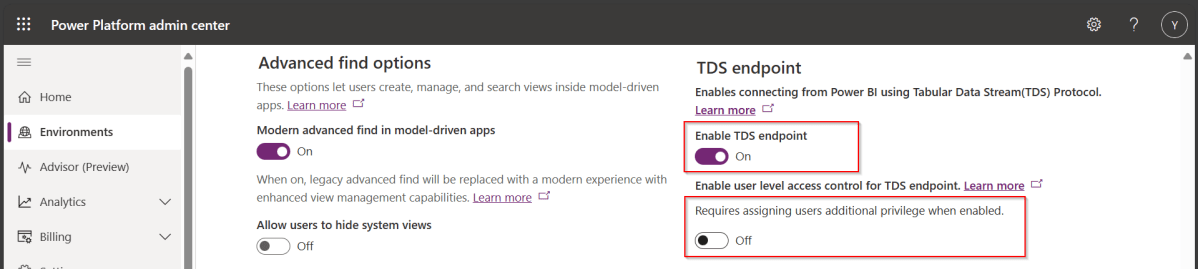
  5. Scroll down to see TDS end point, just enable the TDS end point toggle button
  6. Once this is enabled, you can also enable user level access for this TDS end point by configuring the security role as in the below step.
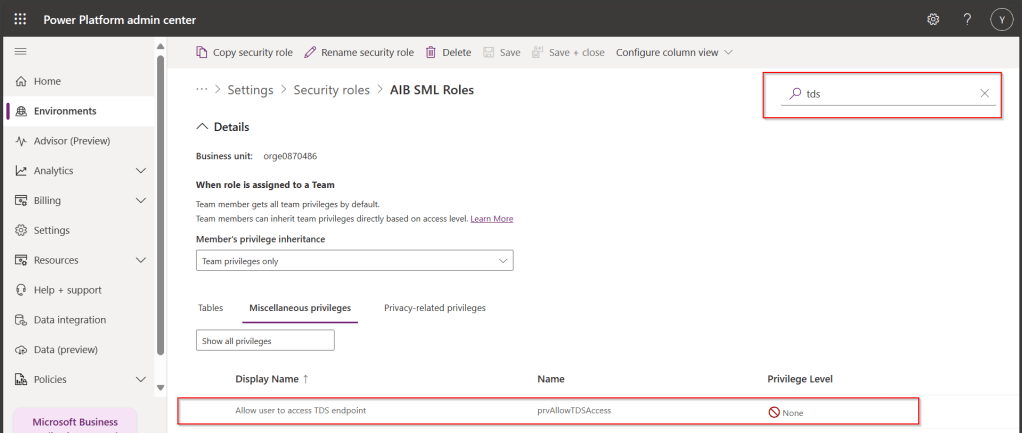
  7. Open Security from Power Platform Admin Center and navigate to the available security roles, go to Miscellaneous privileges, search for tds, you can find a privilege to Allow user to access TDS endpoint.

Advantages:

  1. With this TDS end point enabled, you can directly access the data in the Dataverse tables using SSMS(Preview) and in Power BI
  2. While the interesting part here is that Dataverse security model will be applied to the data being viewed by the user.
  3. That is whenever you were query the dataverse data using SSMS, the user role will be applied
  4. In the same way, if the Power BI report is built using the TDS(SQL end point), any user who is going to access the report will be only seeing the data he/she can access based on current security roles in Dataverse

While this is a cool feature for anyone who is trying to build Dataverse security in Power BI without using row level security as this is a mystery till now.

Hope this helps…

Cheers,

PMDY