Call Custom Actions in Dataverse using Web API – Quick Recap

Hi Folks,

Here is how you can quickly call action using Web API, with this method you can execute a single action, function, or CRUD operation. In the below example, let’s see how you can call an action. Here is function…to achieve this..

var formContext = executionContext.getFormContext();
var message = "Please enter a valid NRIC Number";
var uniqueId = "nric_valid";
var NRIC = formContext.getAttribute("new_nric").getValue();
if(NRIC !== null)
{
var execute_ValidateNRIC = {
NRIC: NRIC, // Call this function only when NRIC value which is non-null
getMetadata: function () {
return {
boundParameter: null,
parameterTypes: {
NRIC: { typeName: "Edm.String", structuralProperty: 1 }
},
operationType: 0,
operationName: "new_ValidateNRIC",
outputParameterTypes: {
IsValid: { typeName: "Edm.Boolean" }
}
};
}
};
Xrm.WebApi.execute(execute_new_ValidateNRIC).then(
function success(response) {
if (response.ok) {
response.json().then(function (data) {
if (!data.IsValid) {
formContext.getControl("new_nric").setNotification(message, uniqueId);
} else {
formContext.getControl("new_nric").clearNotification(uniqueId);
}
}).catch(function (error) {
Xrm.Navigation.openAlertDialog("Error occured from Validate NRIC "+error);
});
}
}
).catch(function (error) {
Xrm.Navigation.openAlertDialog(error.message);
}).catch(function (error) {
Xrm.Navigation.openAlertDialog(error.message);
});
}
}

This example details with Unbound action, which is not tagged to any entity, however if in case on Bound action, you will specify the entity name for bound parameter instead of null. You need to specify the Metadata accordingly for your Action. Let’s understand it’s syntax first…

Xrm.WebApi.online.execute(request).then(successCallback, errorCallback);

Parameters

Stop using OData V2.0 endpoint going further for your implementations….!

Hi Folks,

This blog is just to let you know why you should stop implementing OData calls using V2.0 version. I am pretty sure almost every Dynamics CE project out there have used this OData calls definitely in their implementations from quite some time. While some of new implementations have replaced the logic using Web API, still some people go with using OData V2.0 calls to build their functionality using JavaScript.

Microsoft had actually planned to remove this endpoint from April 30, 2023. But they deferred this because many projects are’nt yet prepared for removal of this end point and help the customers prepare for this transition to Web API end point.

Identify if you still using OData V2.0 end point, actually Organization Data Service is an OData V2.0 endpoint which was introduced with Dynamics CRM 2011..it’s deprecated way back with Dynamics 365 CE version 8.0.

So now, how to identify where and all you were using OData End Points in your code…you shouldn’t expect that existing code will work with only minor changes and this work can be taken at a later stage. This was a high priority warning message from Microsoft stating the removal, so I urge all of you to be prepared for this removal very soon and you shouldn’t be surprised.

So where to change…..?

Below are the places where you should change your way of implementation and align with Microsoft…

  1. The Organization Data Service using this end point /XRMServices/2011/OrganizationData.svc in Javascript, you can find it out with the help of the checker service rule web-avoid-crm2011-service-odata for identification. This can be code which was making OData calls to perform CRUD Operations on the current table or related table.
  2. Check any other code, including PowerShell scripts, that send requests to this endpoint: /xrmservices/2011/organizationdata.svc.
  3. Cross Check your Power BI reports or Excel Data sources that may be using this endpoint.

Note:

This announcement does not involve the deprecated Organization Service SOAP endpoint, meaning using Organization service in plugins. At this time, no date has been announced for the removal of that endpoint. At the time of writing this blog post, Microsoft didn’t announce whether this removal is only for Online or On Premise Versions.

References:

How to use Application Insights to identify usage of the OrganizationData.svc endpoint?

OData v2.0 Service removal date announcement

The Clock is Ticking on Your Endpoint

Do not use the OData v2.0 endpoint

Hope this saves time and effort implementing your Dynamics CE Solutions…

Cheers,

PMDY

Xrm.WebAPI with Promise for synchronous calls in Javascript

Hi Folks,

Here is how I have quickly achieved the synchronous Retrieve multiple call using Web API and Promises with the help of JavaScript. I don’t want to make my post too detail, but I would like to share the approach.

All I want to do is to just Restrict saving the Contact creation if the Postal Code entered is not present in the system. But this call should be synchronous as the message should be shown immediately incase postal code is not found in the system and prevent saving the contact record. All you need to do is simple, just call the below function on change of Postal Code in Contacts.

Here in place of XMLHTTPRequest, I have used Xrm.WebAPI so that it won’t show a critial warning in Solution Checker.

ValidatePostalCode: function (executionContext) {
"use strict";
var formContext = executionContext.getFormContext();
var postalcode = formContext.getAttribute(Resident.Fields.address1_postalcode).getValue();
var message = "Please enter a valid Postal code; Refer to Postal Code Mappings"
var uniqueId = "cnt_postalcodenotpresent";
return new Promise(function (resolve, reject) {
Xrm.WebApi.retrieveMultipleRecords("new_postalcodes", "?$select=new_postalcode&$filter=hsg_postalcode eq '" + postalcode + "' ").then(
function success(result) {
var isNotFound = false;
if(result !== undefined)
isNotFound = result.entities.length === 0 ? true : false;
if (isNotFound) {
var errorMessage = "Postal Code Mapping is not present for the given postal code"
formContext.ui.setFormNotification(errorMessage, "ERROR", uniqueId);
}
else {
Resident.isValidationNeeded = false;
formContext.ui.clearFormNotification(uniqueId);
formContext.data.entity.save();
}
// return true or false
resolve(isNotFound);
},
function (error) {
reject(error.message);
//console.log(error.message);
}
);
});
}

References:

What is Promise?

Web API Retrieve Multiple

Action based on Async Operation

Cheers,

PMDY

Simple Approval Design For Model-Driven Apps

temmyraharjo's avatarTemmy Wahyu Raharjo

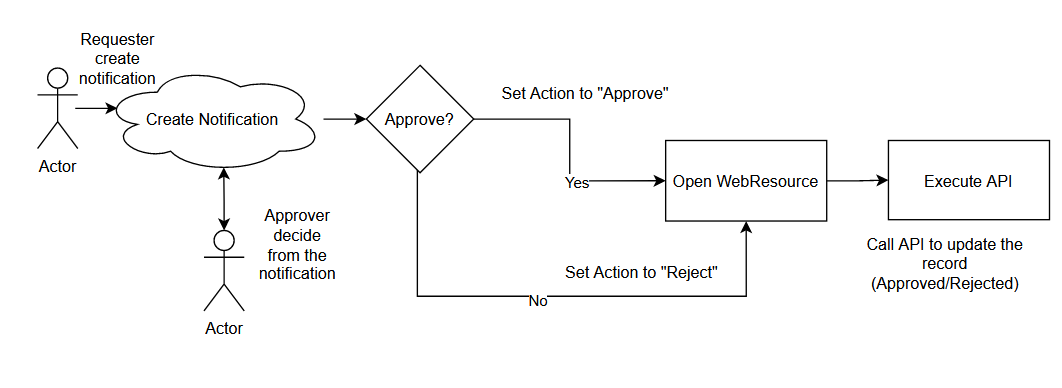
Do you know the In-App Notification feature from Model Driven Apps? This feature can create a notification that targeted a specific User. We also can add action to the notification so the User can also interact with multiple actions (now is limited to just an open URL). In short, this feature is very useful for creating the Approval process. Without further ado, let’s go to my proposed solution! 😎

The Necessary Part

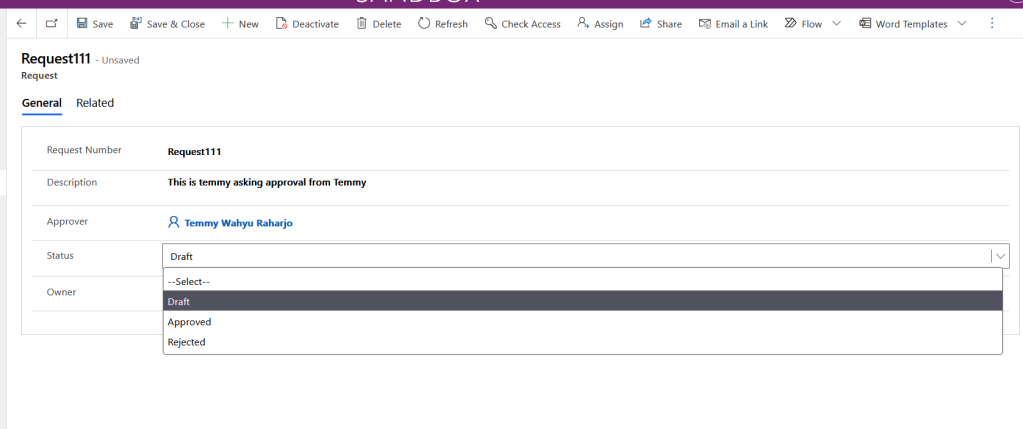
I created the below table for this demonstration purpose:

Request Table

As you can see, the User will fill in the Approver that needs to approve the request. Then in the status field, there are 3 options which are Draft, Approved, or Rejected.

For the next one, you need to create a Model-Driven App. The reason for it is because we need to turn on the feature from the Settings (in top-left from the App > go…

View original post 631 more words

TypeScript Handbook….

Hi Folks,

Here is a brief intro to TypeScript….

Typescript is a strongly typed and built on Javascript. So now you could catch your errors little earlier…TypeScript code converts to JavaScript, which runs anywhere JavaScript runs: In a browser, in your apps etc.

TypeScript offers all of JavaScript’s features, and an additional layer on top of these: TypeScript’s type system. For example, JavaScript provides language primitives like string and number, but it doesn’t check that you’ve consistently assigned these. TypeScript does. This means that your existing working JavaScript code is also TypeScript code. TypeScript is an Object oriented programming language and inherits all the features of OO’Programming.

Microsoft recommends using TypeScript instead of JavaScript in all your Dynamics new implementations and slowly as this gives much flexibity to a developer. So why not learn this and boost your productivity…

Hope this helps…

Cheers,

PMDY